A watch weight is useful only when you know what was on the scale. A complete watch includes its fitted bracelet or strap and fastening hardware. A sized bracelet describes the configuration of that complete watch. A watch-head figure excludes the bracelet or strap, with any remaining attachment parts identified separately.
This guide explains how to read those descriptions and make fair comparisons. It includes a manufacturer’s published specifications and an owner-supplied scale photograph. The two sources are identified separately; neither establishes a standard weight for every watch of the same model.
What each weight description includes
| Description | What the figure covers | What to check |
|---|---|---|
| Complete watch | The assembled watch with its fitted bracelet or strap and clasp or buckle. | Current configuration; whether the bracelet has been sized. |
| Complete watch with a sized bracelet | A complete watch after bracelet adjustment for a particular fit. | Remaining links, half links and counting convention, if recorded. |
| Watch head only | The cased watch without its bracelet or strap. | Whether spring bars, end links or other attachment parts remain. |
| Watch plus loose accessories | A combined load that also includes items such as spare links. | List the extras; do not label this as complete-watch weight alone. |
These are the recording conventions used in this guide. A source may use different labels, so check its description before treating two figures as equivalent. “Complete watch” does not, by itself, mean “all factory-supplied links fitted.”
Why the same reference can have different weights
The reference number is only part of the description. One record may concern a watch on a bracelet, another the watch head, and another a complete watch after links have been removed. A replacement strap or clasp also changes the assembly being weighed.
Citizen’s bracelet sizing guidance describes adding or removing links to adjust fit. Its UK service guidance also explains that removed links are returned with the watch. Those loose links belong in a separate accessory record if you want the weight of the watch as worn. [2] [3]
Changing an adjustment position while retaining exactly the same parts does not, by itself, change the mass of the assembly. Removing a link does. Record the actual change rather than assuming every change in bracelet length produces a weight change.
A manufacturer example with two clearly different objects
Tourby’s archived Lawless 42 page, for reference 6120.1, lists the following figures. Both are manufacturer specifications. [1]
| Metric | Value | Sample / Source | Conditions |
|---|---|---|---|
| Published weight without band | 95 g | Tourby Lawless 42, Ref. 6120.1 | Manufacturer description; attachment-part details not stated. |
| Published weight including steel bracelet | 185 g | Tourby Lawless 42, Ref. 6120.1 | 22/18 steel bracelet; sizing state not stated in these entries. |
The descriptions explain why these numbers answer different questions. They do not establish the weight of your own watch, and the page does not identify the link count used for these entries. Subtracting the published figures would be a calculation from specifications, not a separate weighing of a bracelet.
How to describe a sized bracelet
If the bracelet is known to have been sized but the original link inventory is unknown, a useful label is “Complete watch, sized bracelet, as pictured.” If sizing is unknown, record “Complete watch, bracelet as pictured; sizing state not recorded.” Add the bracelet and clasp identity when known. A photograph should show the configuration that produced the reading.
When recording links, state how you counted them. Distinguish the two sides of the bracelet, note half links, and say whether fixed links and end links are included in the count. A bare total can be ambiguous. Do not claim “full links” just because the watch looks complete.
Keep removed links, spare straps, tags and packaging off the scale when recording the assembled watch. If you want their weight too, make another entry with its own list of included parts.
What watch-head weight can tell you
A head-only record separates the cased watch from the fitted bracelet or strap. It does not require opening the case or removing the movement. You still need to specify the boundary: for example, whether spring bars or detachable end links remain with the head.
You do not need a head-only measurement to publish a useful complete-watch record. Leave the watch assembled if removal is unnecessary or would risk damage.
If both readings come from the same sample and the head is an exactly defined part of the weighed complete assembly, its share of the total can be calculated: watch-head mass divided by complete-watch mass, multiplied by 100. Label this as a derived percentage and identify both input records.
That percentage describes a split between two amounts of mass. It does not locate the centre of mass or measure how the watch feels on a wrist. A weight difference alone also cannot establish authenticity, movement identity or overall quality.
Make a simple complete-watch record
Use the instructions for your actual scale. As one manufacturer example, A&D’s HT instructions describe checking zero, zeroing an empty container when one is used, and waiting for a stable indication. [4]
- Identify the sample and photograph its fitted bracelet or strap. Record the date and the parts included.
- Record the scale make and model, displayed unit and smallest displayed increment. Follow its setup instructions and check zero. Tare a tray before adding the watch.
- Place the whole assembly on the weighing platform or in the tared tray. No part should rest on the table or be supported by your hand.
- Wait for a settled reading and photograph both the watch and the display. Reposition and repeat if practical, retaining every raw reading.
- Publish the reading or a clearly explained summary alongside the configuration. If readings vary, keep that variation visible and check the setup before interpreting a small difference.
Repeated placements are repeat readings of one sample. They are not additional independent watches.
A photographed reading: 143.4 g
The owner-supplied photograph below shows a watch identified by its owner as a VSF Daytona 126500LN-0001 replica, with its bracelet attached. The scale displays 143.4 g.
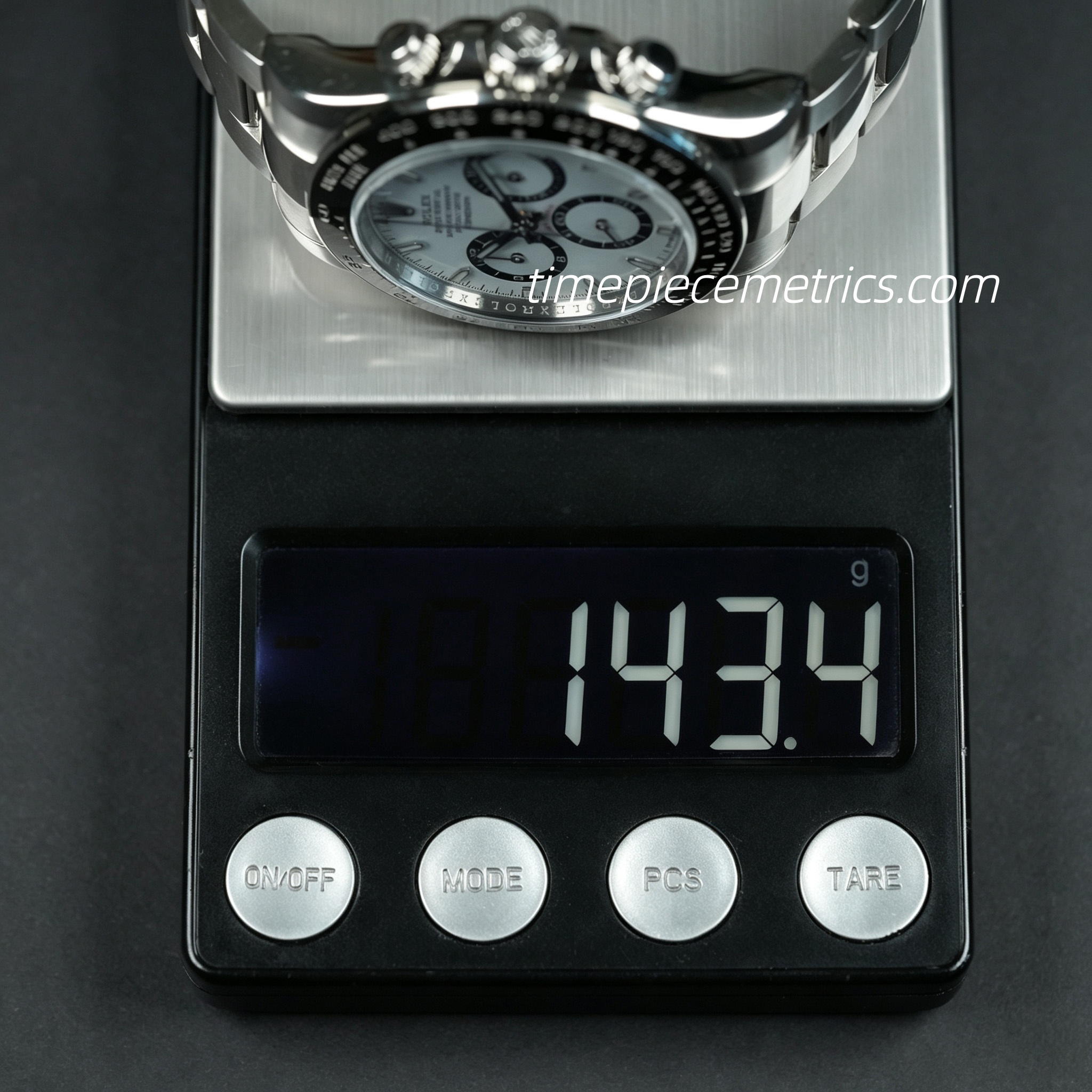
The photograph alone does not show the full bracelet or confirm that every part was supported by the weighing platform. Link count, sizing state and scale setup would need to accompany a complete measurement record.
Use this image as an example of a photographed reading, rather than a standard weight for the model. It does not supply separate watch-head and bracelet weights, and the display’s decimal place does not establish the scale’s accuracy.
Read the last decimal carefully
Readability describes the smallest displayed division. Accuracy concerns agreement with a reference value, while repeatability concerns consistency across repeated placements. Adam Equipment’s glossary treats these as separate descriptions. [6]
Extra decimal places do not establish an accuracy limit. Keep the original readings and explain any rounding; do not append an unsupported plus-or-minus figure. A zero check is also different from documenting calibration. A&D publishes a separate HT calibration procedure that includes a calibration-weight step. [5]
Compare the object before comparing the grams
Before interpreting a difference, match the model and sample identity, the measured object, the fitted bracelet or strap, the included parts and the units. Then check who supplied the number and how it was obtained. If one record lacks its configuration, keep the comparison qualified instead of treating the difference as a property of the watches.
The most useful weight record is one that another reader can understand from its label, configuration and evidence.
Sources
- Tourby Watches Lawless 42.
- Citizen US bracelet sizing guidance.
- Citizen UK links added or removed.
- A&D HT series operating instructions. Operating instructions, English section, PDF page 1
- A&D HT calibration and function setting procedures. Calibration procedure, PDF page 1
- Adam Equipment Weighing Scales Glossary.
Sources checked 3 November 2026. The manufacturer example explains descriptions of weight; it is not a measurement of a Timepiece Metrics sample.
Leave a Reply